FSC-Certified Sustainable Paperboard Buying Guide|100% Recycled vs. Virgin Paperboard: How to Choose?
Are you struggling to find the right sustainable paperboard for your products?
You’re not alone. Many packaging buyers face the same challenges:
“Customers require packaging to be recyclable and eco-friendly, but samples from suppliers are either too soft and deform easily, or the printing looks gray and not premium enough…”
“The new European regulation PPWR requires packaging to be 100% recyclable, but how do I prove it? When suppliers say ‘eco-friendly,’ is it really true?”
“Budget is limited, and 100% recycled paperboard is cheaper than virgin paperboard, but will it meet my load-bearing requirements?”
If these issues sound familiar, you’ve come to the right place.
Sustainable paperboard is not a single product—it’s a category of materials that meet specific environmental standards. When you choose the right type, it can simultaneously deliver on three fronts: brand image, product protection, and environmental compliance.
This guide cuts through the marketing noise and gives you the facts you need to make an informed decision.
In this article, you will learn:
- ✅ Selection comparison of three mainstream sustainable paperboards: SBS, FBB, CRB
- ✅ How to verify certifications: FSC, PEFC, recycled content certification at a glance
- ✅ Cost vs. performance: The real differences between 100% recycled and virgin paperboard
- ✅ Pitfall guide: Which “eco-friendly paperboards” are actually not recyclable?
[Click to get free selection manual + sample application qualification]
1. Definition of Sustainable Paperboard: It Must Meet Three Conditions Simultaneously
From an SEO perspective, we need to first answer the most fundamental user question: What is sustainable paperboard?
Sustainable paperboard is not a marketing concept; it has clear measurement standards. To be called “sustainable,” a paperboard must simultaneously meet:
✅ Condition 1: Sustainable Raw Material Sourcing
- Virgin paperboard: Wood pulp must come from sustainably managed forests certified by FSC (Forest Stewardship Council) or PEFC. The FSC Chain of Custody (COC) certification ensures that forest raw materials and products come from well-managed forests, controlled sources, or recycled materials.
- Recycled paperboard: Raw materials come from post-consumer recycled waste paper, requiring recycled content certification. FSC classifies products into three categories: FSC 100% (from certified forests), FSC Mix (certified materials + controlled materials/recycled materials), and FSC Recycled (using post-consumer recycled materials).
✅ Condition 2: Low-Carbon and Environmentally Friendly Production Process
- Low carbon emissions per unit product
- No use of harmful chemical additives (such as PFAS). The EU PPWR regulation has clearly restricted PFAS content in food contact packaging starting August 12, 2026
- Water resource recycling
✅ Condition 3: Recyclable or Biodegradable After Disposal
- No plastic coatings that hinder recycling. According to PPWR requirements, by 2030 all packaging placed on the EU market must be recyclable, with recyclability performance reaching Class A, B, or C
- Can be sorted and recycled in existing recycling systems
All our sustainable paperboard products are FSC certified. Click to view [certification document samples]
2. In-Depth Comparison of Three Mainstream Sustainable Paperboards (with Selection Comparison Table)
According to search data, “What are the four different types of paperboard?” is a high-frequency long-tail keyword. Focusing on the packaging industry, we highlight the three most commonly used sustainable paperboard types, directly corresponding to your product needs.
1. SBS (Solid Bleached Sulfate Board): Top Choice for Premium Printing Requirements
Core Features:
- Highest whiteness: Pure white surface, made from hardwood bleached chemical pulp, with short fine fibers creating an exceptionally smooth surface
- Raw materials: 100% virgin chemical wood pulp
- Common basis weight: 200-450 g/m²
Applicable Scenarios:
- Luxury packaging (perfume, jewelry, high-end cosmetics)
- Pharmaceutical packaging (requiring high hygiene standards)
- Food gift boxes (meeting FDA food contact requirements)
Environmental Performance:
- ⭐ FSC certification available
- ⭐ No recycled fiber content, but virgin wood pulp source is controllable
- ⚠️ Not suitable for promoting “recycled” concept
Customer Case: After a high-end skincare brand switched to FSC-certified SBS paperboard, packaging costs increased, but they successfully passed EU environmental reviews and secured orders from European retailers.
2. FBB (Folding Box Board): Lightweight, High Stiffness, Cost-Effective Choice
Core Features:
- Three-layer structure: Two layers of chemical pulp sandwiching mechanical pulp in the middle. Mechanical pulp yield is twice that of chemical pulp, with higher wood utilization
- Optimal stiffness-to-weight ratio: Lighter than SBS but with comparable stiffness
- Medium whiteness: Good printing results
Applicable Scenarios:
- Frozen food packaging (low-temperature resistant)
- Chocolate and candy boxes
- E-commerce lightweight packaging
Environmental Performance:
- ⭐ FSC certification available
- ⭐ Higher wood utilization with mechanical pulp, lower carbon footprint
- ⭐ Lightweight reduces raw material consumption
3. CRB (Coated Recycled Board): Top Choice for 100% Recycled Concept
Core Features:
- Gray back white top: White coated surface printable, gray back. Coating can be applied to one or both sides, making the material surface smooth and glossy
- Raw materials: Mixed various recycled fibers, including recovered waste newspaper, old corrugated containers, recovered SBS paperboard, office waste paper, etc.
- Cost: Lower price than SBS paperboard, but quality and printing performance are typically inferior to virgin paperboard
Applicable Scenarios:
- Shoe boxes, toy boxes (non-direct food contact products)
- Dried fruit, cereal outer boxes
- Packaging with low requirements for print quality, strength, and cleanliness
Environmental Performance:
- ⭐ 100% recycled fibers, more environmentally friendly than virgin fiber paperboard, reducing landfill waste
- ⭐ Can be recycled again (provided there is no plastic coating). Note: Coated paperboards are not as easy to recycle as uncoated ones because coatings make fibers harder to break down during the recycling process
- ⚠️ Strength and stiffness lower than virgin paperboard, quality less stable than virgin paperboard
| Comparison Dimension | SBS (Premium Virgin) | FBB (Lightweight High Stiffness) | CRB (100% Recycled) |
|---|---|---|---|
| Whiteness | ⭐⭐⭐⭐⭐ Highest | ⭐⭐⭐ Medium | ⭐⭐ Gray back |
| Stiffness | ⭐⭐⭐⭐ High | ⭐⭐⭐⭐⭐ Optimal | ⭐⭐ Average |
| Print Quality | ⭐⭐⭐⭐⭐ Top-tier | ⭐⭐⭐⭐ Good | ⭐⭐⭐ Acceptable |
| Environmental Concept | Forest Sustainability | Lightweight Low Carbon | Circular Recycling |
| Cost | High | Medium-High | Medium-Low |
| Suitable Products | Luxury goods, Pharmaceuticals | Frozen food, Light packaging | Shoe boxes, Inner boxes |
📏 Don’t Forget the Specs: Securing an FSC certificate or choosing recycled fiber is great for branding, but sustainable packaging must still perform. To ensure your eco-friendly boxes have the exact thickness required for your structural design, check our [cardboard GSM and thickness comprehensive guide] to calculate your physical material specs perfectly.
3. The Truth About 100% Recycled Paperboard: Advantages and Limitations
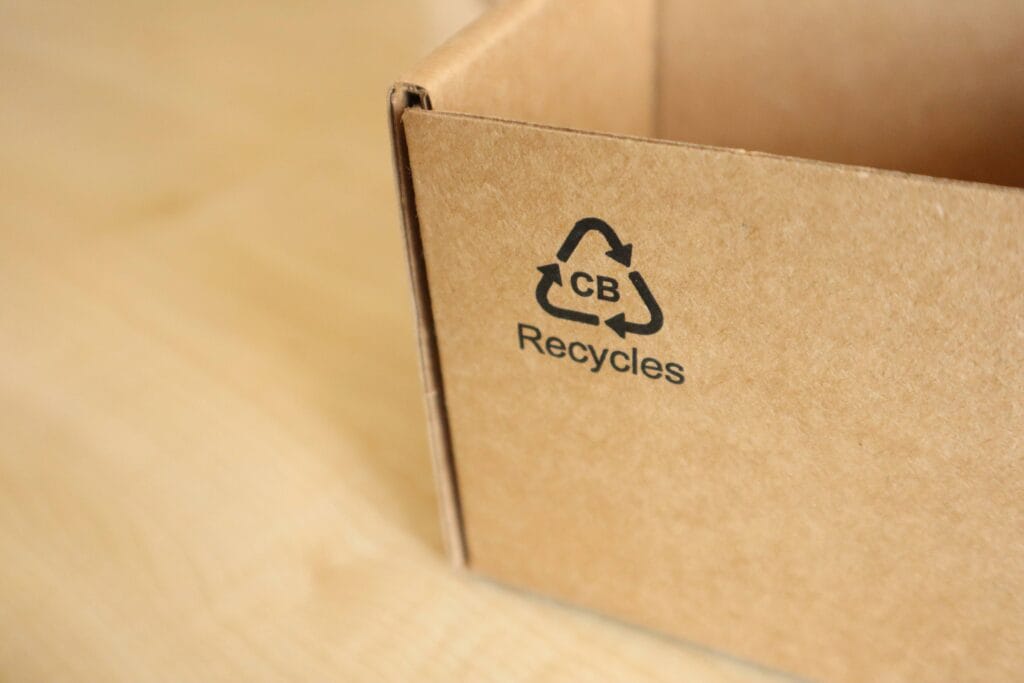
According to search data, “Is 100% recycled paperboard recyclable?” and “What does 100% recycled paper mean?” are high-frequency user questions.
Truth 1: 100% Recycled Paperboard Can Be Recycled Again
Yes, recycled paperboard can re-enter the existing waste paper recycling system to be made into paperboard again, provided there is no plastic coating. However, note: Coated paperboards are harder to recycle because coatings make fibers harder to break down during the recycling process.
Truth 2: 100% Recycled ≠ Performance Equal to Virgin
Fibers become shorter and weaker with each recycling cycle, therefore:
- 100% recycled paperboard has lower stiffness and strength than virgin paperboard
- The quality of recycled paperboard is less stable than virgin paperboard due to different waste paper recycling channels and quality variations
- Not suitable for packaging requiring high strength and cleanliness
Truth 3: Certification Matters More Than Claims
A supplier saying “100% recycled” ≠ actually 100%. Request:
- Recycled content certification (e.g., Greif’s CRB products have RPA 100% certification)
- FSC Recycled certification: FSC Recycled products refer to products using post-consumer recycled materials
Truth 4: Which “Recycled Paperboards” Are Actually Not Recyclable?
- ❌ Those with plastic coating (affects fiber breakdown)
- ❌ Those heavily contaminated with grease/oil (contaminates recycling stream)
- ❌ Those laminated with aluminum foil (multi-layer materials difficult to separate)
Verify PPWR Compliance. Feel the Quality Yourself.
Choosing the right eco-friendly packaging shouldn’t be a gamble. Before you place a bulk production order, check the physical texture, stiffness, and certification data firsthand.
Our factory provides Free Eco-Friendly Material Reference Packs (including FSC-certified, virgin, and 100% recycled paperboard samples) for international buyers.
[ Request Your Free Material Sample Pack ]
4. How to Verify If Suppliers Are Telling the Truth? Three-Step Verification Method
Step 1: Check Raw Material Certification
- Ask: Do you have FSC or PEFC certification?
- Verify: FSC Chain of Custody (COC) certification applies to paper pulp boards, paper packaging, and other paper products. Certificate numbers can be checked for validity on the FSC official website.
- If in doubt: No certification but claiming “eco-friendly” – basically can pass
Step 2: Check Recycled Content
- Ask: What is the recycled fiber content? Is there third-party certification?
- Verify: Request recycled content certification (such as RPA certification). FSC Recycled products require post-consumer recycled materials.
- If in doubt: Only say “contains recycled content” without providing specific data – request test reports
Step 3: Check Recyclability
- Ask: Can this paperboard be recycled in local recycling systems?
- Verify: According to PPWR requirements, by 2030 all packaging must meet Class A/B/C recyclability performance. Is there a third-party recyclability test report?
- If in doubt: Claim “recyclable” but cannot provide evidence – choose carefully
👉 Download our [Supplier Qualification Checklist] and check item by item before purchasing
5. Frequently Asked Questions (FAQ)
A: The core difference lies in lifecycle management. Sustainable paperboard packaging requires: traceable raw material sources (FSC certification), low-carbon production processes, and recyclability after disposal (meeting PPWR requirements). Ordinary paperboard packaging may only meet one or none of these requirements.
A: Not necessarily. It depends on raw material sources and recyclability design. FSC-certified virgin paperboard is environmentally friendly; 100% recycled paperboard is also environmentally friendly; but paperboards with plastic coatings that cannot be recycled are not considered environmentally friendly.
A: From a full lifecycle perspective, currently recognized as more environmentally friendly are: lightweight FSC-certified FBB paperboard (higher wood utilization with mechanical pulp) or 100% recycled CRB paperboard (reducing landfill waste). The choice depends on specific application scenarios.
A: SBS is made entirely from bleached chemical pulp, with short fine fibers creating a smooth surface, high whiteness, and excellent print quality; FBB has a middle layer of mechanical pulp with twice the yield of chemical pulp, offering a better stiffness-to-weight ratio, lighter weight, and lower carbon footprint. If top-tier printing isn’t required, FBB is the more environmentally friendly choice.
A: Yes, theoretically it can be recycled again. However, note that coated paperboards are harder to recycle because coatings make fibers harder to break down during the recycling process. Additionally, if paperboard is severely contaminated by food or has plastic coatings added, it will affect actual recyclability.
A: Mainly three categories: 1) Those with plastic coatings/laminations (coatings make fibers difficult to break down); 2) Those heavily contaminated with food; 3) Those laminated with aluminum foil (multi-layer materials difficult to separate).
6. Help Your Packaging Pass Global Environmental Reviews
Choosing sustainable paperboard is not just an environmental statement; it’s a strategic decision to respond to global regulations, meet consumer expectations, and reduce long-term costs.
- If you pursue top-tier brand image: Choose FSC-certified SBS
- If you want to reduce costs while promoting environmental credentials: Choose 100% recycled CRB
- If you focus on carbon footprint and lightweighting: Choose FBB
Regardless of which type you choose, the key is verifiable, certified, and recyclable.
Three things you can do now:
1️⃣ Get Free Samples: We provide sample sets of three mainstream sustainable paperboards, including copies of certification documents. [Apply now]
2️⃣ Consult with Selection Experts: Tell us your product specifications, and we’ll recommend the most matching paperboard type for free. [Start consultation]
Make your packaging a competitive advantage, not a compliance risk.
Author Profile

-
HONGTUSCENERY is a professional manufacturer of composite paperboard,
providing sustainable and customized packaging solutions for global brands.
With nearly 20 years of industry experience, we focus on material performance,
structural strength, and green supply chain development.
Latest entries
 Double-Sided Kraft Laminated Greyboard2026-10-13Hidden Costs in Kraft Board Procurement: Why the Lowest Price Is Not Always the Best Deal
 Industry Insights2026-10-10How to Reduce Profit Losses from Paperboard Procurement Amid RMB Exchange Rate Fluctuations
 Company News2026-10-03Kraft Paperboard: Applications, Performance Advantages & Sustainability
 Double-Sided Kraft Laminated Greyboard2026-09-305 Key Factors for Choosing a Reliable Kraft Board for Packaging Supplier