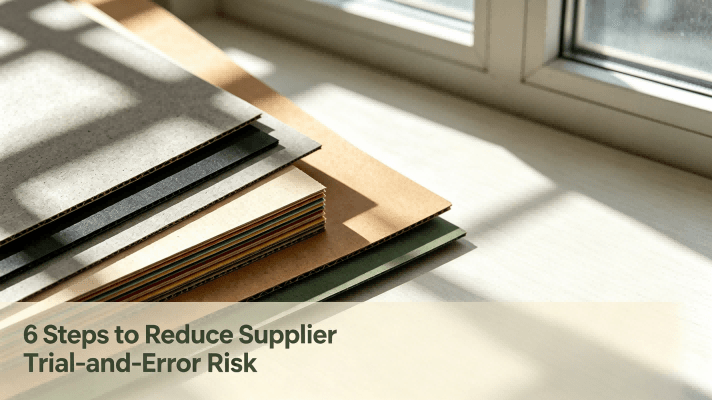
6 Steps to Reduce Supplier Trial-and-Error Risk in Overseas Paperboard Sourcing
For overseas paperboard buyers, the biggest risk when changing suppliers is usually not simply paying a higher price. It is placing the first order and then discovering that the product cannot consistently meet production requirements.
This is especially true for products such as greyboard, black laminated board, colored composite board, and kraft paper laminated greyboard. Their final prices can vary depending on raw materials, thickness, basis weight, structure, surface materials, sheet size, and order quantity. A quotation alone is rarely enough to determine whether a new supplier is truly suitable for long-term cooperation.
When qualifying a new supplier, the goal is not to find a supplier that will “never have problems,” but to identify potential issues before committing to bulk purchases and reduce the cost of trial and error.
A practical six-step process is:
Define the specifications → Test samples → Confirm the TDS → Run a trial order → Test in production → Scale up purchasing
1. Don’t Compare Prices Before Defining the Product
A quotation does not tell you everything about a paperboard product.
Before requesting quotations, prepare a specification sheet that clearly defines the key parameters and product structure, then ask suppliers to quote against the same requirements. This makes it easier to understand whether price differences come from specifications, raw materials, manufacturing processes, or actual production costs.
Paperboard Specifications to Confirm Before Quotation
| Category | What to Confirm |
|---|---|
| Thickness | Actual thickness and allowable tolerance |
| Basis Weight / Structure | Basis weight, number of layers, core and bottom-layer structure |
| Raw Materials | Raw material type and specific description |
| Sheet Size | Length, width, dimensional tolerance, and trimming requirements |
| Certification | Whether certifications such as FSC apply to the specific product |
It is important to note that paperboard raw materials do not have one universal industry-wide “grade” system. A supplier’s raw material description does not necessarily represent the final performance of the board.
Therefore, even when two suppliers provide similar TDS data, their prices may still differ. Raw materials, manufacturing processes, and actual application performance all need to be evaluated together with sample testing.
For more on why paperboards with similar TDS specifications can still have different prices:
Paperboard Performance: Beyond TDS and Price
2. Don’t Judge Samples by Appearance Alone
Once you receive samples, don’t simply decide whether they “look good.” Test them according to their final application.
| Test | What to Verify |
|---|---|
| Stiffness | Whether the board provides sufficient support and forming performance |
| Structure | Whether the actual structure matches the agreed specification and whether the board is prone to delamination or breakage |
| Cutting Quality | Whether die-cutting or cutting causes excessive burrs, edge cracking, or dust |
| Folding / Creasing | Whether the board tends to delaminate or break |
| Paper Lamination | Whether bubbling or deformation occurs |
| Batch Comparison | Whether performance remains consistent between samples or batches |
This is particularly important for composite paperboard.
The real question is not simply whether the sample is good, but whether the board can enter your production process and perform as required during actual processing.
3. Use the TDS to Confirm the Agreed Specifications
A Technical Data Sheet (TDS) helps turn the product requirements discussed during the quotation stage into a clear technical reference.
At this stage, focus on confirming that the supplier’s TDS matches the specifications you have already agreed on, and check whether it provides relevant performance data such as:
- Hardness
- Stiffness
- Other application-related performance indicators
The final confirmed specifications should preferably be included in the purchase order or contract.
This gives both sides the same reference point when evaluating the first order. If a problem occurs, you can compare the delivered product against the agreed specifications rather than relying on subjective judgments.
4. Don’t Choose the Smallest Possible Trial Order
The purpose of the first order is not simply to buy a small quantity of paperboard. It is to verify whether the supplier is suitable for long-term purchasing.
Therefore, the trial-order specifications and quantity should be as representative as possible of your future purchasing requirements.
A practical process is:
Sample → Trial Order → Incoming Inspection → Production Testing → Final Product Evaluation
If the trial order is significantly different from the specifications, production conditions, or application of future bulk orders, a successful trial does not necessarily mean that the supplier is suitable for long-term purchasing.
5. Look at Supply Stability and After-Sales Support

Product quality is only part of supplier evaluation. You also need to consider whether the supplier can support your future purchasing needs.
Focus on four areas:
- Stable production capacity
- Effective quality control
- Stable lead times and sufficient regular stock
- A clear process for handling quality or delivery problems
For overseas buyers, the value of a supplier is not simply providing a low-priced sample. The supplier should also be able to support replenishment with stable supply and respond effectively when quality or delivery problems occur.
6. Build a Six-Step Verification Process
The entire supplier-qualification process can be summarized into six steps:
Step 1: Define the Specifications
Confirm thickness, basis weight, structure, raw material description, sheet size, and certification requirements.
Step 2: Test Samples
Test stiffness, structure, cutting quality, folding/creasing, and paper-lamination performance according to the final application.
Step 3: Confirm the TDS
Use the TDS to confirm the agreed specifications and relevant performance indicators, and include the final requirements in the purchase order or contract.
Step 4: Run a Trial Order
Choose specifications and an order quantity that represent your future purchasing conditions as closely as possible.
Step 5: Test in Production
Inspect the delivered board first, then run it through the actual production process and evaluate the final product.
Step 6: Scale Up Purchasing
Once the key verification steps have been completed successfully, gradually increase the purchasing volume.
Conclusion
For overseas paperboard buyers, reducing supplier trial-and-error risk does not mean finding a supplier that will “never have problems.” It means using specification confirmation, sample testing, TDS verification, and production testing to identify potential problems before committing to large-volume purchases.
Ultimately, what you need to verify is not only the paperboard’s price or TDS, but whether:
the paperboard supplied by this supplier truly fits your production process and can consistently meet your purchasing requirements.
Need to verify a paperboard supplier for your next order?
Contact us to discuss your specifications, samples, and production requirements.
Author Profile

-
HONGTUSCENERY is a professional manufacturer of composite paperboard,
providing sustainable and customized packaging solutions for global brands.
With nearly 20 years of industry experience, we focus on material performance,
structural strength, and green supply chain development.
Latest entries
 Double-Sided Kraft Laminated Greyboard2026-10-13Hidden Costs in Kraft Board Procurement: Why the Lowest Price Is Not Always the Best Deal
 Industry Insights2026-10-10How to Reduce Profit Losses from Paperboard Procurement Amid RMB Exchange Rate Fluctuations
 Company News2026-10-03Kraft Paperboard: Applications, Performance Advantages & Sustainability
 Double-Sided Kraft Laminated Greyboard2026-09-305 Key Factors for Choosing a Reliable Kraft Board for Packaging Supplier