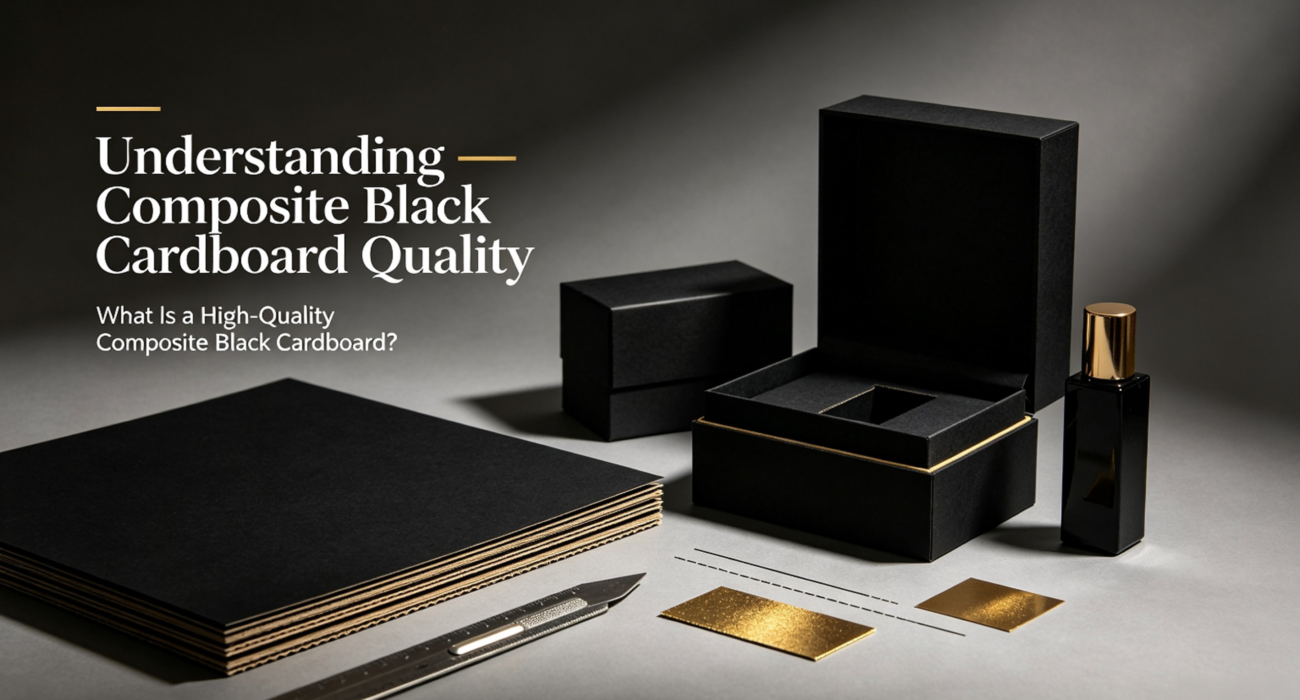
Understanding Composite Black Cardboard Quality: What Is a High-Quality Composite Black Cardboard?
When purchasing composite black cardboard, many packaging manufacturers face a practical question: different suppliers claim that their composite black cardboard offers consistent color, good stiffness, and reliable quality—but how can buyers actually determine which product is high quality?
For cosmetic packaging, luxury packaging, gift boxes, and premium retail packaging, composite black cardboard affects not only the visual appearance of the package but also die-cutting, folding, lamination, hot stamping, and the final box structure.
Therefore, evaluating composite black cardboard should not be based only on a single sample or the price per ton. Buyers should consider color consistency, thickness and stiffness, lamination strength, surface quality, and actual processing performance.
What Is Composite Black Cardboard?
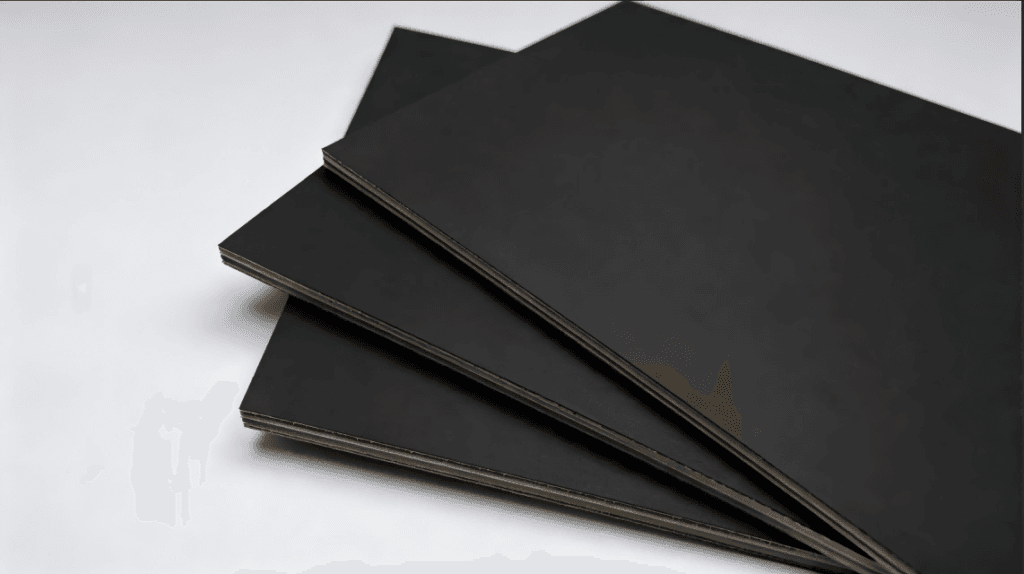
Composite black cardboard is a paperboard product made by bonding multiple layers of paper through a lamination process. Different paper layers and materials can be combined to balance color, thickness, stiffness, surface quality, and processing performance.
Compared with single-layer black paper, a composite structure can be adjusted according to different packaging requirements to provide suitable thickness and structural performance. It is therefore used for gift boxes, cosmetic packaging, luxury packaging, retail packaging, and other applications where both appearance and structure are important.
It is important to note that there is no single mandatory A/B/C grading system that applies across the entire composite black cardboard industry. Therefore, when a supplier describes a product as “Grade A” or “Grade B,” buyers should first ask: what criteria are used to define that grade?
For example, does the supplier classify products based on color, GSM, thickness, stiffness, lamination strength, surface quality, or processing performance?
Instead of comparing the name “Grade A,” it is more useful to compare the specific product specifications and test results provided by each supplier.
What Determines the Quality of Composite Black Cardboard?
1. Black Color Consistency
Color is one of the most visible quality characteristics of composite black cardboard.
High-qualitycomposite black cardboard should provide a uniform black appearance and maintain consistency between different production batches as much as possible.
For luxury and cosmetic packaging in particular, noticeable color variation within the same order can affect the visual consistency of the finished packaging.
Therefore, buyers should not evaluate only one sample. A better approach is to request samples from different production batches and confirm how color control and acceptance are handled.
If the customer has specific color requirements, the supplier can also be asked to confirm the applicable color measurement and acceptance method rather than relying on subjective descriptions such as “deep black” or “good color.”
2. Stable Thickness and Stiffness
The thickness and stiffness of composite black cardboard directly affect packaging structure.
Rigid boxes, gift boxes, and premium retail packaging often require sufficient board stiffness. Significant thickness variation may affect die-cutting dimensions, folding positions, and the final box structure.
Buyers should therefore consider:
- Nominal thickness versus actual thickness;
- Whether thickness is consistent across different areas;
- Whether different production batches remain consistent;
- Whether the board stiffness is suitable for the specific box structure.
An important purchasing principle is:
Do not only ask how thick the composite black cardboard is. Also ask how stable the thickness is during actual production.
For packaging manufacturers, consistency is often more important than a single sample meeting a particular specification.
3. Lamination Strength
Because composite black cardboard consists of multiple layers, interlayer bonding is an important quality factor.
If lamination strength is insufficient, the board may experience delamination, bubbling, or edge cracking during die-cutting, folding, lamination, or transportation.
These problems can affect the appearance of finished packaging and increase material waste and rework.
Therefore, buyers can request relevant quality information from suppliers and conduct actual processing tests with samples.
For packaging products requiring complex folding or multiple finishing processes, actual testing can provide more useful information than simply reviewing product specifications.
4. Surface Quality and Processing Performance
Composite black cardboard is normally not the final product but a material used in packaging production.
It may undergo printing, lamination, hot stamping, embossing, die-cutting, and folding. Surface flatness, dimensional stability, and processing suitability can therefore affect the final packaging result.
A composite black cardboard product suitable for packaging production should not simply look black. It should also maintain stable performance during subsequent processing.
What Is the Difference Between High-Quality and Low-Cost Composite Black Cardboard?
Price is often the first factor buyers compare when purchasing composite black cardboard.
However, the lowest purchase price does not necessarily mean the lowest actual cost.
If composite black cardboard has problems such as color variation, unstable thickness, insufficient lamination strength, or poor processing suitability, it may result in:
- Higher die-cutting waste;
- Folding or box-forming failures;
- Additional rework;
- Material waste;
- Quality complaints.
A more useful approach is to consider the total cost of use:
Total Cost of Use = Purchase Price + Processing Losses + Rework Costs + Quality Risks
This is why packaging manufacturers making long-term purchases should compare not only supplier quotations but also sample performance, batch consistency, and actual production results.
How Should Composite Black Cardboard Be Selected for Different Packaging Applications?

A thicker or stiffer composite black cardboard product is not necessarily better for every application.
Different packaging applications require different product characteristics.
Cosmetic packaging often places greater emphasis on surface appearance, color consistency, printing, and finishing performance.
Gift packaging generally places greater emphasis on stiffness, structural stability, and overall visual quality.
Luxury packaging may require a combination of color consistency, surface quality, thickness, stiffness, hot stamping, embossing, and other finishing requirements.
Therefore, the right selection should be based on:
Packaging Structure + Product Weight + Processing Requirements + Final Appearance
rather than simply choosing the thickest or stiffest composite black cardboard.
What Should Be Tested Before Purchasing Composite Black Cardboard?
Before placing a bulk order, packaging manufacturers should not rely only on a single sample provided by the supplier. Actual production testing is recommended.
Key items to check include:
| Test Item | Recommended Verification |
|---|---|
| Black Color Consistency | Compare samples from different batches to confirm color stability |
| GSM (Grammage) | Measure actual grammage and compare it with the agreed specification |
| Thickness | Measure multiple points and compare them with the supplier’s specification |
| Stiffness | Test the board through actual box forming and structural applications |
| Lamination Strength | Conduct folding and die-cutting tests and check for delamination |
| Surface Quality | Check flatness and performance during printing, lamination, and hot stamping |
| Processing Performance | Conduct die-cutting and folding tests using actual production equipment |
For large-volume purchasing, testing only once is not always sufficient.
If possible, buyers should validate multiple production batches, because this provides a better indication of long-term supplier consistency than testing a single sample.
How Can Buyers Evaluate a Composite Black Cardboard Supplier?
Product quality is important, but the supplier’s production capacity and quality control capabilities are equally important.
A reliable composite black cardboard manufacturer should be able to control the overall production process:
Raw Materials → Lamination → Thickness Control → Color Control → Surface Inspection → Finished Product Inspection
Buyers can further evaluate:
- Whether product specifications are clearly defined;
- Whether samples and quality information can be provided;
- Whether batch-to-batch consistency can be maintained;
- Whether the supplier has stable production capacity;
- Whether different specifications can be supplied according to customer requirements;
- Whether MOQ, lead time, and shipping conditions are suitable for long-term purchasing.
For export buyers, the supplier’s ability to maintain stable and continuous supply is also part of product quality.
How Do Manufacturers Ensure Composite Black Cardboard Quality?
Consistent composite black cardboard quality does not come from a single final inspection. It comes from continuous control throughout the production process.
From raw material selection to lamination, and from thickness and color control to surface and finished-product inspection, every stage can affect the final product.
For long-term customers, batch consistency is particularly important.
Packaging manufacturers do not simply need one “good sample.” They need composite black cardboard that delivers a consistent level of performance with every order.
Therefore, when evaluating a supplier, the ability to reproduce stable quality consistently should be an important consideration.
Does Composite Black Cardboard Have Grade A, B, and C?
There is currently no single mandatory A/B/C grading system that applies to all composite black cardboard suppliers.
If a supplier uses internal Grade A, B, or C classifications, buyers should ask for the specific criteria behind those grades, such as color, GSM, thickness, stiffness, lamination performance, surface quality, or other internal quality indicators.
Do not compare only the grade name. Compare the actual specifications and inspection requirements behind the grade.
For long-term purchasing, it is better to ask the supplier to provide clear product specifications and quality acceptance criteria so that both sides have the same understanding of what constitutes an acceptable product.
What Is the Real Value of High-Quality Composite Black Cardboard?
The value of high-quality composite black cardboard is not simply providing a black packaging material. It is about achieving a stable balance between appearance, structure, processing performance, and production cost.
For packaging manufacturers, the key factors are:
Black Color Consistency + GSM Stability + Thickness and Stiffness + Reliable Lamination Strength + Batch Consistency
When these characteristics remain stable during large-volume production, composite black cardboard can become a reliable packaging material.
Therefore, when choosing composite black cardboard, do not only ask:
“How much does this composite black cardboard cost?”
A better question is:
“Can this composite black cardboard consistently meet our packaging production requirements?”
For packaging companies purchasing in the long term and in large volumes, stable quality, reliable processing performance, and consistent supply are the real value of high-quality composite black cardboard.
What Should Buyers Ask Suppliers Before Purchasing Composite Black Cardboard?
Before placing an order, buyers can request:
- Product specification sheet;
- Samples and samples from different production batches;
- Relevant quality inspection information;
- Recommended processing conditions;
- MOQ, lead time, and trade terms;
- Sample testing based on the actual packaging application.
Following the process of Specification Confirmation → Sample Testing → Actual Processing → Batch Verification → Bulk Purchasing can provide a more reliable way to determine whether a composite black cardboard product is suitable for long-term use than simply comparing supplier quotations.
Author Profile

-
HONGTUSCENERY is a professional manufacturer of composite paperboard,
providing sustainable and customized packaging solutions for global brands.
With nearly 20 years of industry experience, we focus on material performance,
structural strength, and green supply chain development.
Latest entries
 Double-Sided Kraft Laminated Greyboard2026-10-13Hidden Costs in Kraft Board Procurement: Why the Lowest Price Is Not Always the Best Deal
 Industry Insights2026-10-10How to Reduce Profit Losses from Paperboard Procurement Amid RMB Exchange Rate Fluctuations
 Company News2026-10-03Kraft Paperboard: Applications, Performance Advantages & Sustainability
 Double-Sided Kraft Laminated Greyboard2026-09-305 Key Factors for Choosing a Reliable Kraft Board for Packaging Supplier