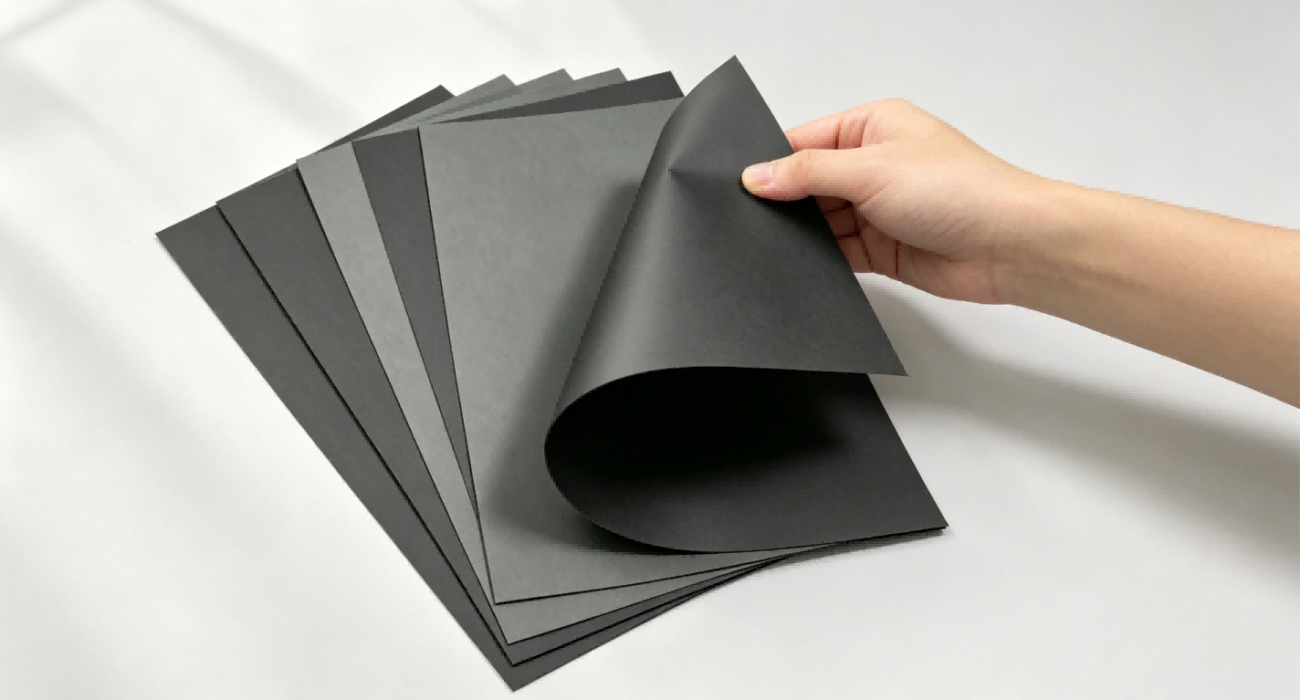
How Much Does Black Cardboard Cost? Key Factors That Affect Black Cardboard Pricing
Different suppliers can offer significantly different prices for what appears to be the same black cardboard. What makes it even more confusing is that the products may all be called “Black Cardboard,” and their GSM may look similar, yet the quotations can still vary considerably.
This does not necessarily mean that the lower-priced product is poor quality, nor does a higher-priced product automatically mean it is the better choice.
The real question is: Are you actually comparing the same product?
1. How Much Does Black Cardboard Cost?
There is no single fixed price that applies to all black cardboard products.
Quotations can vary depending on the supplier, product specifications, and purchasing conditions. Instead of giving a seemingly precise “market price,” it is more useful to understand what affects the quotation and how to compare different suppliers properly.
When requesting a quotation, you should clearly specify at least:
- GSM and thickness
- Sheet size
- Single-sided or double-sided black
- Final application
- Estimated order quantity
- FSC or other certification requirements
- Trade terms such as FOB or CIF
The more specific your requirements are, the more meaningful the quotation will be.
2. Why Do Different Suppliers Offer Different Prices?

The first question to ask is:
Are the suppliers actually quoting the same type of black cardboard?
Even when products are all called “Black Cardboard,” their specifications may be different.
Common factors that can affect the quotation include:
Different raw materials
Some black cardboard products use a higher proportion of virgin wood pulp, while others use recycled pulp or a mixture of both. Different raw material structures can affect cost, strength, and overall performance.
Different blackness and color consistency
For standard packaging, basic black appearance may be sufficient. For premium packaging, covers, and display products, however, buyers may place greater importance on blackness, color stability, and consistency between production batches.
Different surface performance
Black cardboard can vary in surface smoothness, gloss, printability, and suitability for further processing.
Different certification and compliance requirements
If a project requires FSC, food-contact requirements, REACH, RoHS, or other compliance requirements for a particular market, these requirements may also affect the quotation.
Different sizes and order quantities
Even for the same product, sheet size, order quantity, packaging requirements, production scheduling, material waste, and logistics can all affect the final quotation.
Therefore, price comparisons only become meaningful when the product specifications, certification requirements, and commercial terms are substantially the same.
3. Does a Higher Price Mean Better Black Cardboard?
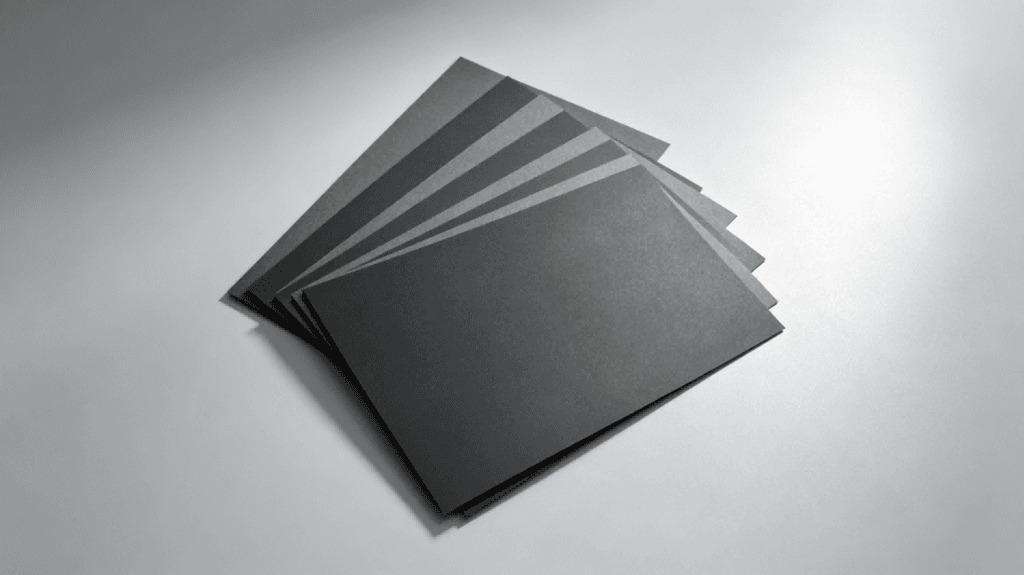
Not necessarily.
A higher-priced product may offer better raw materials, blackness, surface performance, or converting performance. But these additional features are not necessarily required for every application.
For example:
If the black cardboard is used for standard structural packaging and the appearance and blackness requirements are relatively basic, a product that meets the essential performance requirements may be the more economical choice.
On the other hand, for premium gift boxes, cosmetics packaging, book covers, or display products, blackness, surface appearance, stiffness, and converting performance may be more important. In these cases, a higher-grade product may be justified.
Therefore, procurement should not simply follow the principle of:
“The cheaper, the better” or “The more expensive, the better.”
A better approach is:
Do not sacrifice necessary performance just to reduce the price, but do not pay for specifications you do not actually need.
4. Single-Sided or Double-Sided Black?
This is an important factor that is sometimes overlooked when sourcing black cardboard.
Single-sided black is usually suitable when only one surface needs to have a black appearance.
If the inside of the finished product will not be clearly visible, or the inside color is not important, single-sided black may be sufficient.
Double-sided black is more suitable when both sides need to maintain a consistent black appearance, such as:
- Premium gift boxes
- Folders
- Book covers
- Display cards
- Decorative packaging
- Paper products where both sides are visible
Double-sided black does not automatically mean “better.” It simply means that both surfaces need to meet the required appearance and blackness standards.
If only the outside of your finished product needs to be black, there may be no reason to choose double-sided black simply because it sounds more premium.
5. How Can You Tell Which Quotation Offers Better Value?
Do not compare only the number on the quotation. Compare the conditions behind the quotation as well.
| Comparison Item | What to Confirm |
|---|---|
| Product specifications | GSM and thickness |
| Black structure | Single-sided / double-sided black |
| Raw materials | Virgin pulp / recycled pulp and ratio |
| Appearance | Blackness, color consistency, surface |
| Certification | FSC, food-contact requirements, etc. |
| Sheet size | Whether the size is exactly the same |
| Quantity | MOQ and actual order quantity |
| Trade terms | FOB, CIF, etc. |
| Packaging | Packaging method and requirements |
| Samples | Whether the product has been tested |
For example:
Supplier A may offer a lower price, but the quotation may not include the certification you require, or the product may actually be single-sided black.
Supplier B may offer a higher price, but the quotation may include double-sided black, a specific sheet size, and the certifications you need.
These two quotations cannot be compared directly.
On the other hand, if two suppliers offer essentially the same specifications, certifications, sizes, quantities, and trade terms, but their prices are still significantly different, it is worth asking:
Why is there a difference in price?
6. Three Things to Confirm Before Placing an Order
1. What specifications does my application actually require?
Define the thickness, sheet size, single-sided or double-sided black requirement, and final application.
2. Does the quotation include the certifications and requirements I need?
Confirm whether FSC, food-contact requirements, and other compliance requirements for your target market are included.
3. Does the sample actually work for my production?
Do not evaluate the cardboard based only on its appearance.
If your finished product requires printing, die-cutting, creasing, folding, or other converting processes, it is better to test the sample under actual production conditions.
Conclusion
The price of black cardboard is not determined simply by the words “Black Cardboard.”
GSM, thickness, raw materials, blackness, surface performance, single-sided or double-sided black, certifications, sheet size, order quantity, and trade terms can all affect the quotation.
So instead of simply asking:
“How much does black cardboard cost per ton?”
a better question is:
“What is the overall purchasing cost for black cardboard that meets my specifications and application requirements?”
A more reliable procurement process is:
Define your requirements → Compare equivalent specifications → Request samples → Test the product → Calculate the overall cost → Choose the right product
The right black cardboard is not necessarily the product with the highest specifications or the lowest price. It is the product that meets your application requirements while keeping the overall purchasing cost reasonable.
Author Profile

-
HONGTUSCENERY is a professional manufacturer of composite paperboard,
providing sustainable and customized packaging solutions for global brands.
With nearly 20 years of industry experience, we focus on material performance,
structural strength, and green supply chain development.
Latest entries
 Double-Sided Kraft Laminated Greyboard2026-10-13Hidden Costs in Kraft Board Procurement: Why the Lowest Price Is Not Always the Best Deal
 Industry Insights2026-10-10How to Reduce Profit Losses from Paperboard Procurement Amid RMB Exchange Rate Fluctuations
 Company News2026-10-03Kraft Paperboard: Applications, Performance Advantages & Sustainability
 Double-Sided Kraft Laminated Greyboard2026-09-305 Key Factors for Choosing a Reliable Kraft Board for Packaging Supplier