Single-Sided vs Double-Sided Black Paperboard: A Purchasing Guide for Packaging Manufacturers
If your product only needs one black surface, Single-Sided Through-Black Paperboard is the more cost-efficient choice. If both sides, cut edges, and folded areas need to remain black, Double-Sided Through-Black Paperboard is more suitable, with better stiffness and flatness at the same thickness.
For packaging manufacturers, choosing black paperboard is not only about color. Material structure, basis weight, stiffness, converting requirements, application, and purchasing cost all need to be considered.
1. 30-Second Selection Guide: Which One Should You Choose?
Start with three questions:
① Does your product only need one black side?
Yes → Choose Single-Sided Through-Black Paperboard
Suitable for:
- Packaging liners
- Separators
- Standard folding cartons
② Do both sides and cut edges need to remain black?
Yes → Choose Double-Sided Through-Black Paperboard
Suitable for:
- Hang tags
- Double-sided visible gift boxes
- Premium packaging
③ Do you require higher stiffness and flatness?
Yes → Consider Double-Sided Through-Black Paperboard
At the same thickness, it provides better stiffness and flatness.
Quick Decision Table
| Requirement | Recommended Grade |
|---|---|
| Lower material cost | Single-Sided Through-Black |
| Only one side needs to be black | Single-Sided Through-Black |
| Packaging liners and separators | Single-Sided Through-Black |
| Standard folding cartons | Single-Sided Through-Black |
| Both sides are visible | Double-Sided Through-Black |
| Black cut edges are required | Double-Sided Through-Black |
| Folded areas should remain black | Double-Sided Through-Black |
| Higher stiffness at the same thickness | Double-Sided Through-Black |
| Premium packaging | Double-Sided Through-Black |
2. What Is Single-Sided Through-Black Paperboard?
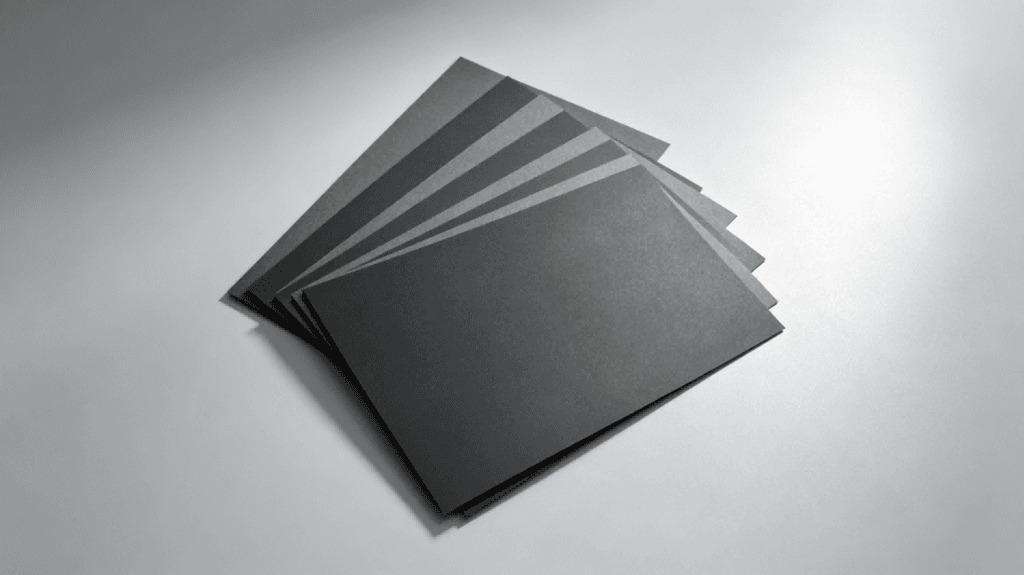
Single-Sided Through-Black Paperboard is produced using an internal dyeing process.
The front side is solid black, while the reverse side has a lighter natural pulp color. The paper core is also black, so there is no grey core when the board is cut.
Compared with grey-back black paperboard, it provides a more complete black appearance. Compared with double-sided black paperboard, it offers a more cost-efficient solution.
The material uses:
30% Imported Virgin Wood Pulp + 70% Selected Recycled Pulp
The virgin wood pulp helps improve fiber strength and reduces the risk of tearing during bundling, die-cutting, and converting.
Key Features
- Solid black front side
- Black paper core
- No grey core when cut
- More complete black appearance than grey-back black board
- More cost-efficient than double-sided black paperboard
- Good fiber strength
- Suitable for die-cutting, creasing, hot stamping, and screen printing
3. What Is Double-Sided Through-Black Paperboard?
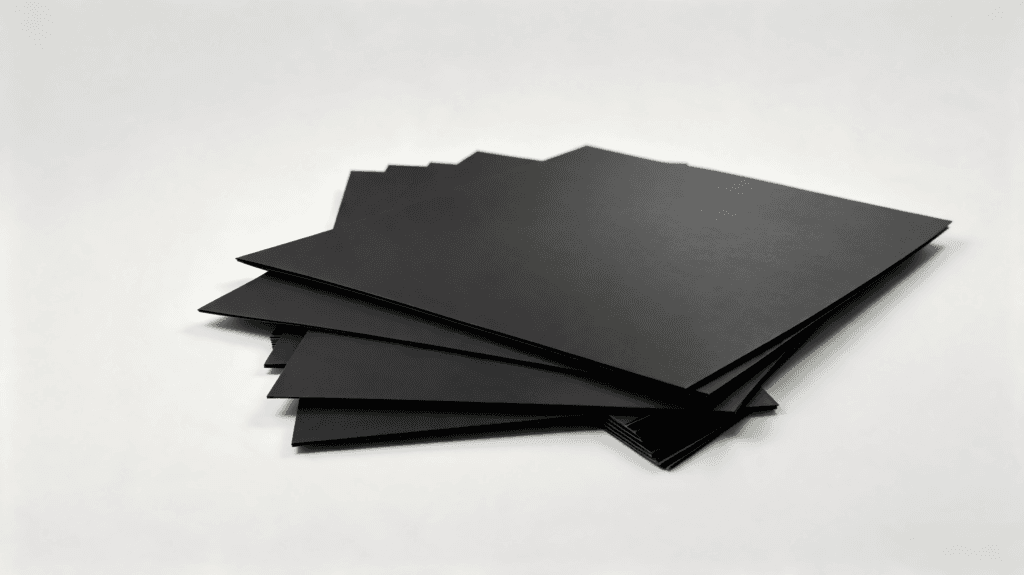
Double-Sided Through-Black Paperboard is also produced using an internal dyeing process, but both sides and the entire paper core are black.
This allows the inside and outside of the finished product to maintain a consistent black appearance.
The cut edges remain black, and folded areas are less likely to show white edges, making it suitable for packaging where visual consistency is important.
The material uses:
30% Imported Virgin Wood Pulp + 70% Selected Recycled Pulp
The virgin wood pulp helps improve the fiber bonding and stability of recycled pulp while maintaining cost efficiency.
Key Features
- Black on both sides
- Black throughout the paper core
- Black cut edges
- Less likely to show white edges after folding
- Good color fastness
- Better stiffness at the same thickness
- Better flatness
- Suitable for premium packaging
4. Single-Sided vs Double-Sided Black Paperboard: Key Differences
The main differences are black structure, edge appearance, stiffness, flatness, cost, and application requirements.
| Feature | Single-Sided Through-Black | Double-Sided Through-Black |
|---|---|---|
| Black Structure | Black front side and core | Black on both sides and throughout the core |
| Reverse Side | Light natural pulp color | Black |
| Paper Core | Black, with no grey center | Entirely black |
| Cut Edge | No grey core, but reverse-side color may be visible | Remains black |
| Folding | Suitable for standard structures | Less likely to show white edges |
| Stiffness | Stable | Better at the same thickness |
| Flatness | Stable | Better |
| Color Fastness | Stable | Higher |
| Cost | More cost-efficient | Relatively higher |
| Main Advantage | Balance of cost and converting performance | Visual consistency and stiffness |
| Typical Applications | Liners, separators, standard cartons | Hang tags, premium packaging, double-sided visible products |
5. Application Scenarios and Recommended Basis Weights
The appropriate basis weight depends on the product size, structure, converting process, and required stiffness. The following ranges are common reference points.
Single-Sided Through-Black
Packaging Liners and Separators
105–160 gsm
Suitable for:
- Packaging liners
- Separator sheets
- Product dividers
If the reverse side is not visible, this grade can meet the functional requirements while helping control material costs.
Standard Folding Cartons
250–300 gsm
Suitable for:
- Standard folding cartons
- Product packaging
- Retail packaging
Suitable for common converting processes such as die-cutting, creasing, hot stamping, and screen printing.
Double-Sided Through-Black
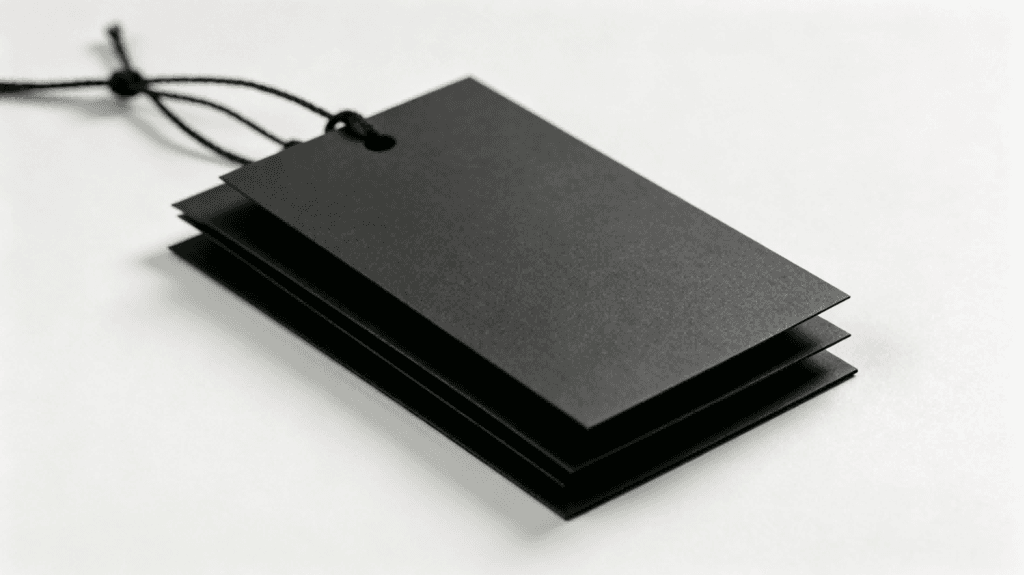
Hang Tags and Double-Sided Visible Gift Boxes
300–350 gsm
Suitable for:
- Fashion hang tags
- Premium product tags
- Double-sided visible gift boxes
- Luxury packaging
Both sides and cut edges remain black, making the material suitable for products requiring a consistent visual appearance.
Art and Photography Backgrounds
180–230 gsm
Suitable for:
- Art background boards
- Photography backgrounds
- Product display backgrounds
Premium Rigid and Hardcover Packaging
400–450 gsm
Suitable for:
- Premium rigid boxes
- Hardcover products
- Luxury presentation packaging
- Specialty black packaging
The double-sided black appearance, combined with better stiffness and flatness, helps maintain the structure of the finished product.
6. What Happens If You Choose the Wrong Black Paperboard?
Black paperboard is not simply a matter of choosing the more expensive option. The material should match the actual requirements of the finished product.
If You Need Double-Sided Black but Choose Single-Sided
For example, a double-sided visible gift box may have:
- Visible lighter areas inside;
- Cut edges that do not achieve the desired black appearance;
- Less consistent visual performance around folded areas.
If You Use Double-Sided Black for a Simple Liner
This may result in:
- Unnecessary material costs;
- Performance that is not fully utilized;
- Higher purchasing costs for high-volume production.
Double-Sided Through-Black Paperboard is not always better. It is better when the application actually requires a double-sided black appearance.
7. Hongtu Scenery Black Paperboard Solution

Hongtu Scenery produces black paperboard using a 2600 mm wide paper machine and an internal dyeing process. We offer:
- Single-Sided Through-Black Paperboard
- Double-Sided Through-Black Paperboard
Our current products use:
30% Imported Virgin Wood Pulp + 70% Selected Recycled Pulp
Note: The pulp ratio, basis weight, thickness, and other specifications mentioned above are based on Hongtu Scenery’s current products and are not universal industry standards. Specifications and material formulations may vary between manufacturers.
Product Features
- Matte, low-reflection surface
- Good fiber strength
- Stable stiffness
- Good flatness
- Suitable for die-cutting, creasing, hot stamping, and screen printing
For high-volume orders, 2600 mm wide jumbo rolls are available to help reduce slitting waste. slitting capabilities, jumbo-roll supply can help reduce slitting waste and support large-scale production.
8. Why Choose Hongtu Scenery?
For black paperboard purchasing, product specifications are only the starting point. Packaging manufacturers also need materials that can perform consistently during production.
Clear Material Structure
We clearly distinguish between Single-Sided Through-Black and Double-Sided Through-Black Paperboard, helping customers select the appropriate grade for their finished products.
Flexible Basis Weight Selection
The appropriate basis weight can be selected according to product size, box structure, converting process, and stiffness requirements rather than simply purchasing based on price.
Large-Scale Production
Our 2600 mm wide paper machine supports large-volume production, with jumbo-roll supply available for suitable customers.
Application-Based Recommendations
Customers can provide:
Application + basis weight + size + converting process + order quantity
We can then recommend a suitable black paperboard grade and supply format.
9. Conclusion: Choose Based on Your Packaging Requirements
The right black paperboard should be selected according to the visual requirements, structural needs, converting process, and cost target of the finished product.
For applications where the reverse side is not visible, Single-Sided Through-Black Paperboard can provide the required black appearance and converting performance without adding unnecessary material costs.
For products where both inside and outside surfaces, cut edges, and folded areas need to remain consistently black, Double-Sided Through-Black Paperboard provides a more complete visual solution, with better stiffness and flatness at the same thickness.
Choosing the right grade and basis weight at the beginning can help avoid unnecessary material costs while reducing the risk of problems during converting or in the final packaging appearance.
Author Profile

-
HONGTUSCENERY is a professional manufacturer of composite paperboard,
providing sustainable and customized packaging solutions for global brands.
With nearly 20 years of industry experience, we focus on material performance,
structural strength, and green supply chain development.
Latest entries
 Double-Sided Kraft Laminated Greyboard2026-10-13Hidden Costs in Kraft Board Procurement: Why the Lowest Price Is Not Always the Best Deal
 Industry Insights2026-10-10How to Reduce Profit Losses from Paperboard Procurement Amid RMB Exchange Rate Fluctuations
 Company News2026-10-03Kraft Paperboard: Applications, Performance Advantages & Sustainability
 Double-Sided Kraft Laminated Greyboard2026-09-305 Key Factors for Choosing a Reliable Kraft Board for Packaging Supplier