What Paperboard Performance Should Buyers Compare Besides TDS and Price?
When purchasing paperboard, buyers usually start by comparing thickness, grammage, moisture, strength, and price.
These specifications are important for confirming whether a product meets the basic requirements. However, when two suppliers provide similar TDS (Technical Data Sheet) figures, their actual processing performance can still be different.
For paperboard used for die-cutting, creasing, folding, laminating, or box making, the performance of the sample during actual processing also matters.
1. Stiffness: Is the Paperboard Stiff Enough?
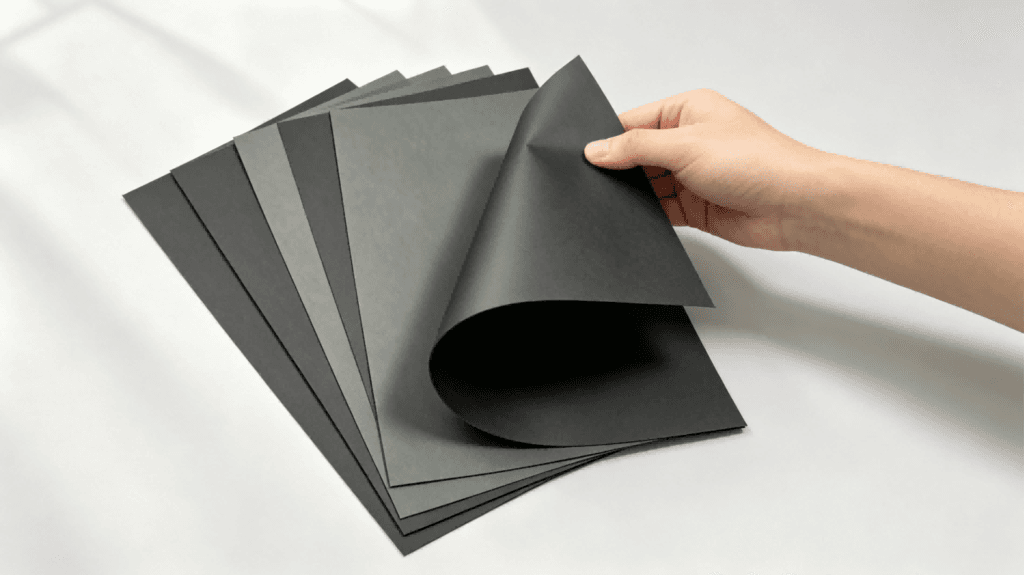
The same thickness does not necessarily mean the same stiffness.
Stiffness affects how well paperboard maintains its shape during processing and use. For applications such as book covers, folders, and rigid boxes, the board needs enough support while still being suitable for folding and forming.
When comparing samples, use the same board size for bending, folding, or forming tests.
Thickness is a measured value, while stiffness is closer to how the board actually performs in use.
However, higher stiffness is not always better. For products that require folding, creasing, or forming, the important question is whether the stiffness is suitable for the specific application and processing method.
2. Internal Structure: The Same Thickness Can Have a Different Structure
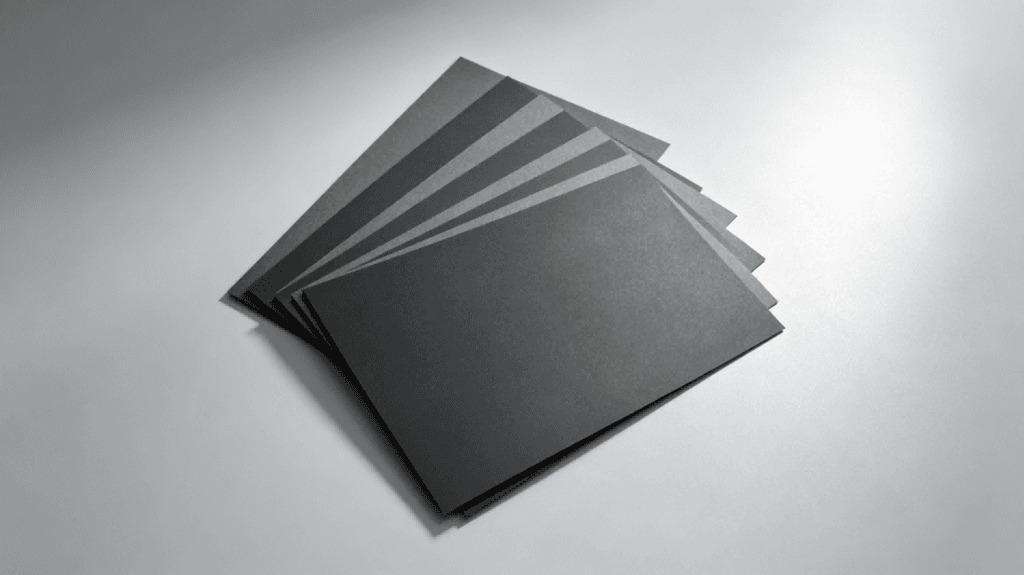
Grey board and other composite paperboards are often made from multiple layers. Differences in raw materials, layer combinations, bonding between layers, and manufacturing processes can affect the final performance.
As a result, two products with similar thickness and grammage may still behave differently during processing.
For example, unstable bonding between layers can cause delamination, edge lifting, or cracking during die-cutting and folding.
These structural differences may not be fully reflected in a standard TDS.
Therefore, besides checking thickness, buyers can also examine the board’s cross-section and combine this observation with actual processing tests.
3. Cutting Quality: How Cleanly Does It Die-Cut?
For paperboard that requires die-cutting, cutting quality is an important practical consideration.
When comparing a supplier’s sample with a locally sourced board, test both materials using the same equipment, tooling, and processing conditions whenever possible.
Look for:
- Clean and even cutting edges
- Burrs or rough edges
- Fuzzing or fiber picking
- Delamination
- Problems with small or complex shapes
- Consistency during continuous processing
These results can provide a better indication of whether the board is suitable for actual production than comparing TDS figures alone.
After all, the goal of purchasing paperboard is not simply to obtain an attractive TDS, but to run production smoothly.
4. How Should TDS and Sample Testing Be Used Together?
This does not mean that TDS is unimportant.
TDS is useful for confirming specifications, screening suppliers, and establishing quality requirements. Sample testing helps determine whether the material is suitable for a specific production process.
For example:
Supplier A: 2.0 mm, a certain GSM, and a certain price
Supplier B: 2.0 mm, similar GSM, and a different price
Based on these figures alone, the two boards may appear interchangeable.
But after die-cutting, creasing, folding, or forming tests, their actual performance may be different.
If different suppliers quote significantly different prices for the same grey board thickness, thickness alone should not be used to assume that the products have the same cost or performance. Raw materials, structure, and manufacturing processes can all contribute to the difference. For more detail, see Why Can Grey Board Suppliers Quote Very Different Prices for the Same Thickness?.
A practical purchasing process is therefore:
TDS screening → Sample testing → Actual processing comparison
rather than comparing price and specifications alone.
5. What Should You Compare When Testing Paperboard Samples?
When comparing a supplier sample with a locally sourced board, test them under the same processing conditions whenever possible.
| Item | What to Observe |
|---|---|
| Thickness | Stability and uniformity |
| Grammage | Whether it meets the required specification |
| Stiffness | Resistance to bending and deformation |
| Internal structure | Delamination or cracking |
| Cutting | Cleanliness of the cut edge |
| Creasing | Clarity and consistency |
| Folding | Cracking along the fold |
| Laminating | Bubbling or delamination |
Conclusion
TDS and price are the starting points for paperboard purchasing, but they are not the whole picture.
When two products have similar TDS figures, it is worth comparing their:
Stiffness, internal structure, and cutting quality.
Depending on the final application, you can then test their creasing, folding, and laminating performance.
For paperboard that will enter actual production, the key question is not only whether the specifications and price look right, but:
Can the board be processed consistently under your actual production conditions?
That is why sample testing is an important step in determining whether a paperboard is truly suitable for production.
Author Profile

-
HONGTUSCENERY is a professional manufacturer of composite paperboard,
providing sustainable and customized packaging solutions for global brands.
With nearly 20 years of industry experience, we focus on material performance,
structural strength, and green supply chain development.
Latest entries
 Double-Sided Kraft Laminated Greyboard2026-10-13Hidden Costs in Kraft Board Procurement: Why the Lowest Price Is Not Always the Best Deal
 Industry Insights2026-10-10How to Reduce Profit Losses from Paperboard Procurement Amid RMB Exchange Rate Fluctuations
 Company News2026-10-03Kraft Paperboard: Applications, Performance Advantages & Sustainability
 Double-Sided Kraft Laminated Greyboard2026-09-305 Key Factors for Choosing a Reliable Kraft Board for Packaging Supplier